Practical web design guides for US business owners. The patterns that kill conversion, when to fix vs when to rebuild, how to make slow sites fast, choosing the right platform for the next 5 years, and protecting yourself from ADA lawsuits. No fluff, no platform lobbying.

Somebody drove forty minutes to see a truck that sold on Saturday. That is not a customer service problem, it is a data problem, and most dealers do not find out they have it until it happens twice.
Read article →
Someone recommends your firm at a dinner. The next morning the person looks you up. Whatever happens in those two minutes decides whether they call, and most firms have never thought about that moment at all.
Read article →
There is a version of the insurance agency website that almost every agency has: a stock photo of a family, a list of coverage types, an About Us page, and a phone number. It is not wrong exactly. It just does not do anything.
Read article →
Most clinic websites in the US that ask any patient for contact information are violating HIPAA, and most owners have no idea. The Office for Civil Rights has issued fines from $40,000 to $1.5 million per incident over the last five years for exactly this. The frustrating part is that fixing it is straightforward when you know what to look for. This article covers what HIPAA compliance for a clinic website actually requires in 2026, without the consultant jargon.
Read article →
There are 65 million Hispanics living in the United States, more than the entire population of France. Roughly 42 million of them speak Spanish at home. They are also the fastest-growing patient demographic in healthcare, with a higher rate of insurance enrollment and outpatient visits than any other segment over the last five years. And almost every US clinic has a website that quietly excludes them. This is not about Google Translate. This is about a healthcare experience that actually works in two languages.
Read article →
There is a quiet decision most US restaurant owners make without realizing they are making it. They build a website that shows the menu, the address, and the hours, and they let DoorDash and UberEats handle the actual orders. The result is a 25 to 30 percent commission on every digital sale, indefinitely. A website that takes orders is the single highest-ROI infrastructure decision a small restaurant can make today.
Read article →
Telemedicine in the US went through three phases in five years. 2020-2021 was emergency adoption. 2022-2023 was retrenchment as practices figured out what worked and what did not. By 2025, telemedicine settled into a permanent role: about 22 percent of all outpatient visits in the US are now telehealth, and that number is stable. The clinic websites that were built before this transition are missing four specific things patients now expect to see. The clinics that have updated for it are capturing the patient flow.
Read article →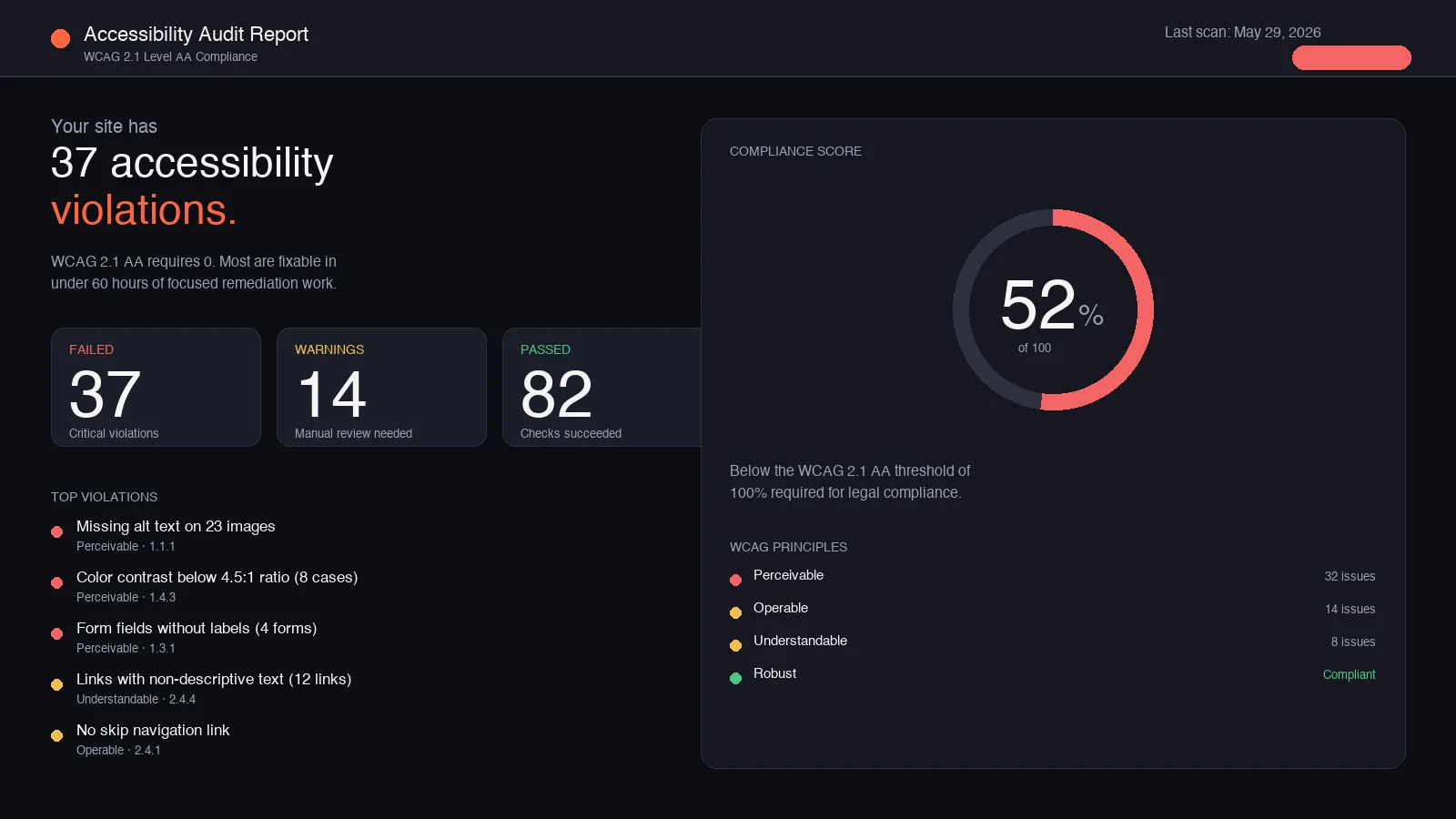
ADA accessibility lawsuits against US small business websites went from a rare occurrence in 2018 to over 4,000 federal filings per year in 2025. Most US small business owners don't know their website is non-compliant. Most law firms specializing in this area target small businesses specifically because they're easier targets than enterprise sites. The compliance work is bounded and achievable. The legal risk of ignoring it is real and growing. Here is what you need to know.
Read article →
Every conversation about a new US small business website eventually arrives at the platform question. WordPress, Webflow, custom-built, or Squarespace. Each platform has a loud lobby that insists it's the best. None of them is actually best for every business. The right answer depends on five questions that most platform decisions skip. Here is the honest comparison that helps you choose well.
Read article →
The average visitor to a professional services site spends between 40 and 50 seconds before deciding to stay or return to Google. In that window the prospect decides if your firm is serious, if you understand their problem, and if it's worth filling out the contact form. Most sites waste those seconds entirely.
Read article →
If your US small business website takes more than 3 seconds to load on mobile, you're losing customers before they ever see your offer. This isn't a marginal optimization. It's a primary conversion killer that most small business owners ignore because the fix sounds technical. The actual work is bounded, well-understood, and pays back faster than almost any other website investment. Here is what moves the needle in 2026.
Read article →
Your law firm website is a form of attorney advertising under every state Bar in the US. The rules vary by state, but the principles are consistent: truthfulness, no false promises, no improper solicitation. Most firms violate at least one of these without realizing it.
Read article → When a US small business website is underperforming, the owner usually faces the same dilemma: should we redesign what we have, or should we rebuild from scratch? The wrong choice can waste tens of thousands of dollars and 6 months of progress. The right choice depends on a small set of structural questions most owners haven't been asked yet. Here's the framework that prevents the wrong answer.
Read article →
Most US law firm websites fail at the basics. They are missing the sections prospective clients actually look for, and they are stuffed with sections nobody reads. This is the minimum structure a serious legal website needs, based on what actually converts visits into retained clients.
Read article →
Your website is getting traffic but not converting. Before you spend more on ads, find and fix the leaks.
Read article →
Shopify is faster. Custom is more flexible. Neither is always right. Here's how to make the decision without regretting it in 18 months.
Read article →We build modern websites for US small businesses. Fast, accessible, mobile-first, SEO-ready. We pick the right platform for your business, not the most profitable one for us. Free audit, no sales pitch.
Request a quote →Tell us what you need and we'll get back to you. No commitment, no sales pitch.
We use cookies to measure how the site gets used and for ads. Accept them or turn them down.
 Salomon Web Services